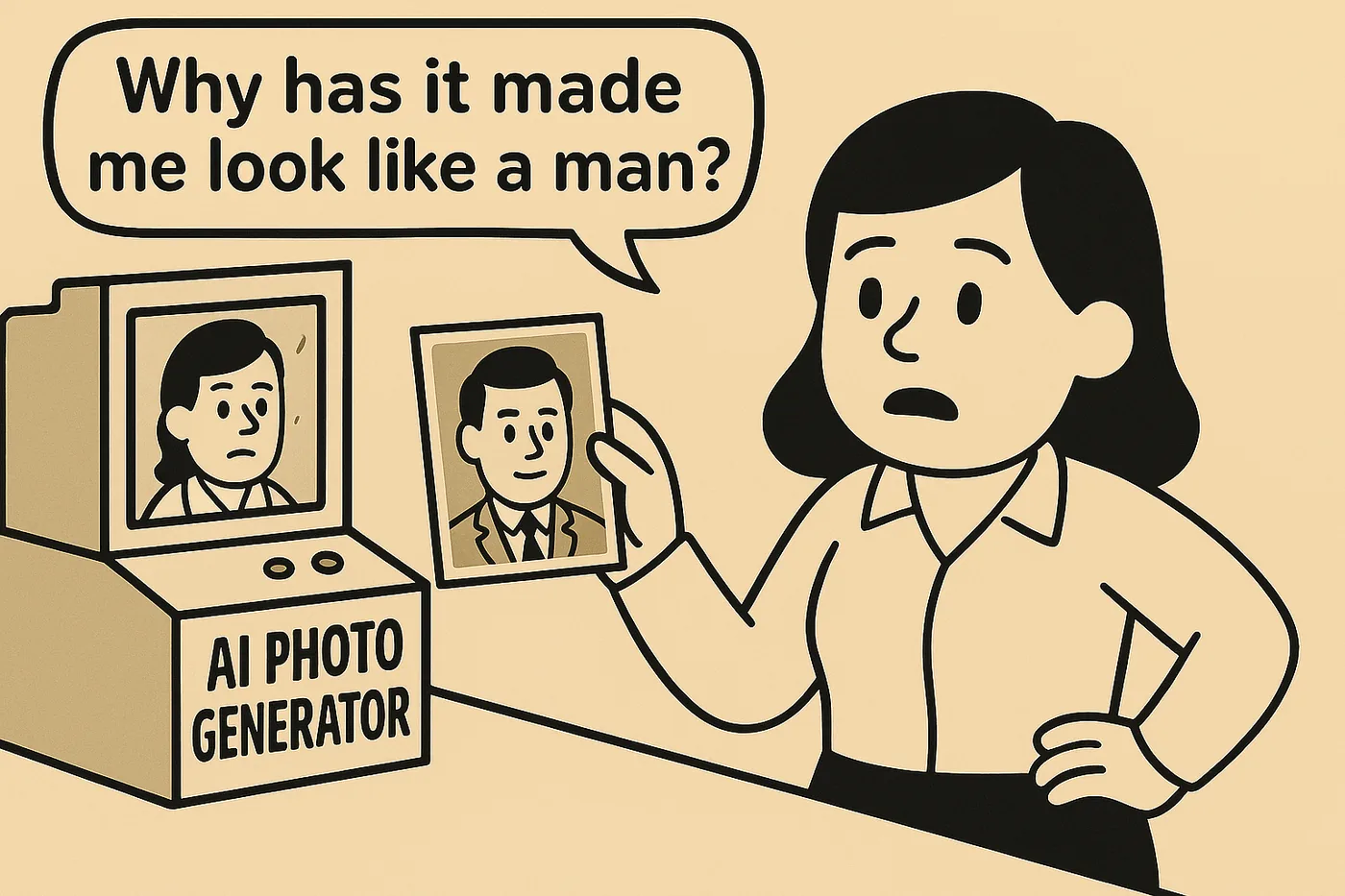
Artificial Intelligence should promise impartiality. Unlike humans, AI doesn’t get tired, impatient or hangry, and AI outputs are purely based on the inputs, meaning AI disregards characteristics such as gender, accent, or skin colour of the person providing the input. And yet, over and over again, it turns out AI is regularly biased, and sometimes spectacularly so. AI systems can cause significant, often unintentional, negative impacts. They might generate only male images for CEOs and only female images for nurses, or they might offer higher-interest credit loans to minority groups. In a well-publicised example at Amazon, an AI recruitment system downgraded women’s applications because they didn’t look like the ones that succeeded in the past. The system had taught itself to prefer male candidates, so it penalised terms like “women’s” and downgraded graduates of all-female colleges. Amazon tried to fix it but ultimately they scrapped the tool because it couldn’t be trusted to make fair decisions.
So what’s going on here? And more importantly, what can we do about it?
What is bias in AI, and why does it matter?
Bias in AI occurs when systems make decisions that are unfair, prejudiced, or systematically skewed, often because of the data they were trained on. AI models learn from data, and as the saying goes "garbage in, garbage out". If AI models are trained on biased data from the internet, they are likely to reflect back the world as the internet portrays it, a world full of historical inequalities and structural imbalances.
This matters to everyone because AI is increasingly involved in decisions that affect people’s lives, in hiring, education, healthcare, finance, and even law enforcement. Even small amounts of bias in these systems can scale quickly and quietly. Importantly, people may not even know they’ve been treated unfairly or have any way to appeal. The results aren’t just embarrassing, and they can be damaging. Recent examples have shown bias in mortgage applications, healthcare and recruitment.
How does bias creep into the system?
There are three common culprits:
-
Biased data: Most modern AI models are trained on enormous datasets scraped from the internet or drawn from historical records. If the source material is biased, as much of the internet is, the outputs will be too.
-
Poorly defined goals: If an AI system is trained to optimise for the “best” candidate or the “most relevant” image without very carefully defining what that means, the AI system will make its own assumptions. Often the outputs will then reflect existing stereotypes.
-
Lack of oversight: AI models are often developed behind closed doors with little transparency. Without rigorous testing and visibility of the training data, biases can go unnoticed until they cause real and noticeable harm.
Can’t we just tidy up the data?
Cleaning up data helps, but it’s not enough. Bias doesn’t just lie within the data and it can also occur in how we frame problems, define success, and interpret outputs. Even seemingly neutral inputs can produce skewed results when filtered through a flawed model or incentive structure.
Debiasing AI isn’t a one-time data-cleaning job. It’s an ongoing process that includes:
-
Diverse teams building and testing models
-
Clear standards for fairness and accountability
-
Transparency about how systems work and are evaluated
-
Input from affected communities, not just engineers
Right now, most major AI systems are what experts call “black boxes.” Their inner workings are secret, and their impact is often hard to trace. That’s a problem, particularly when they’re used in public services or critical decision-making.
What can you do about it?
If you’re building or using AI tools, whether in education, hiring, healthcare, or beyond, here are some practical steps you can take:
-
Ask questions about training data. Where does it come from? Who is represented, and who isn’t? Where might bias occur?
-
Test for edge cases. Does the system behave differently across different demographic groups? Try a few tests with different backgrounds, different genders or different names to see if and how the output is affected.
-
Monitor outputs regularly. Bias isn’t always obvious at first glance, so look for patterns in the outputs over time.
-
Push for transparency. If you’re buying or using AI tools, ask how they were tested and what measures are in place for fairness.
-
Invest in AI Literacy. AI literacy isn’t just about how to prompt, and it’s also important to learn to critically evaluate the outputs and spot when something seems off.
Using AI responsibly doesn’t mean avoiding it altogether, and it requires adopting AI with eyes open so you can understand how the tools work and evaluate the outputs.
The Red Giant says...
Bias in AI isn’t just a bug, and its outputs often represent a mirror held up to society. That means we can do something about it. Building fairer AI starts with recognising that bias exists, asking questions, and making deliberate choices about how these tools are trained, tested, and used. We can’t code our way out of inequality, but with care and accountability and responsible use, we can make sure that the AI systems and tools we build reflect our best values and not our worst habits.