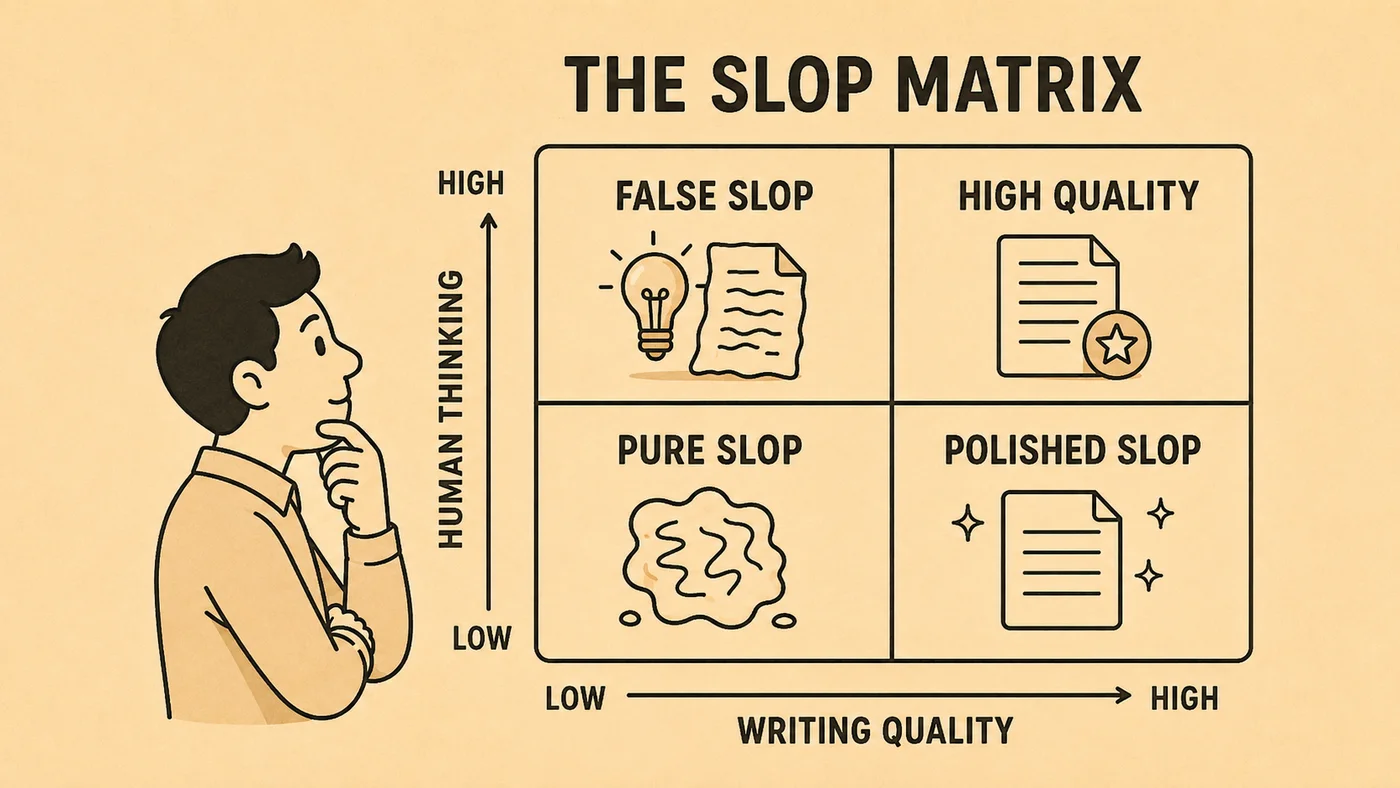
Perhaps predictably, AI slop is appearing everywhere we look. Scroll any social media feed and you’ll see it within a few posts, the same recycled phrasing and structures, both within the posts themselves and the comments below. The problem was so commonplace last year that Merriam-Webster chose “slop” as its word of the year in 2025, and it’s become worse since then.
Slop is not just a social media story, it’s a significant workplace issue too. In September 2025, Harvard Business Review published research from Stanford and BetterUp Labs that gave it a name, “workslop”, defined as “AI-generated content that looks good, but lacks substance”. Around 40% of the full-time employees they surveyed had received some in the previous month. I suspect that number is much higher now, and I suspect many of us now receive some form of “workslop” on at least a weekly basis.
The cost of slop can go well beyond readability. Slop in marketing material erodes customer trust, while slop in proposals and tenders can lead directly to lost business. Slop in a strategy paper or a board pack can lead to decisions being based on incorrect data, and slop in internal communications can lead to information being missed. Workday’s research at the start of this year, across 3,200 employees, found that nearly 40% of the time AI saves is lost again to rework. Every piece of slop has a potential knock-on effect on a business, and the question is much greater than “was AI used in this?”.
So AI slop is a problem, but when I look closely at what people are calling slop, I’ve noticed there are different types of content receiving the same slop label. If we can separate those it could help us to overcome the problem.
Two capabilities for quality content
Arguably, whether a piece of writing is worth someone’s time comes down to two things:
The amount of human thinking: AI typically produces a ‘median’ output, a kind of average of everything it has read, so it takes thinking to move content away from that average and towards something worth saying. Broadly speaking, the more human thinking that goes into a piece of content, the more worthwhile it will be, whereas if you don’t do any thinking, you may as well just give people a prompt so they can generate the content themselves.
The quality of the writing: Writing quality can be subjective, so there is no set standard for quality writing. At a minimum, though, the words should carry the thinking clearly enough for a reader to receive it. Beyond that, AI writing is full of giveaways, and when people perceive AI was used to produce writing they can become dismissive of the content. Those giveaways will likely change over time, but using AI to write without personalising it loses our individuality and will continue to risk people perceiving it as AI generated.
We can use these two capabilities to produce a two-by-two grid, which I’ve called The Slop Matrix. Without either, you get pure slop, and with both, you get high-quality work. Those two corners are the obvious ones, and the interesting places are the other two, where one capability is present and the other is missing. I’ve called them Polished Slop and False Slop.
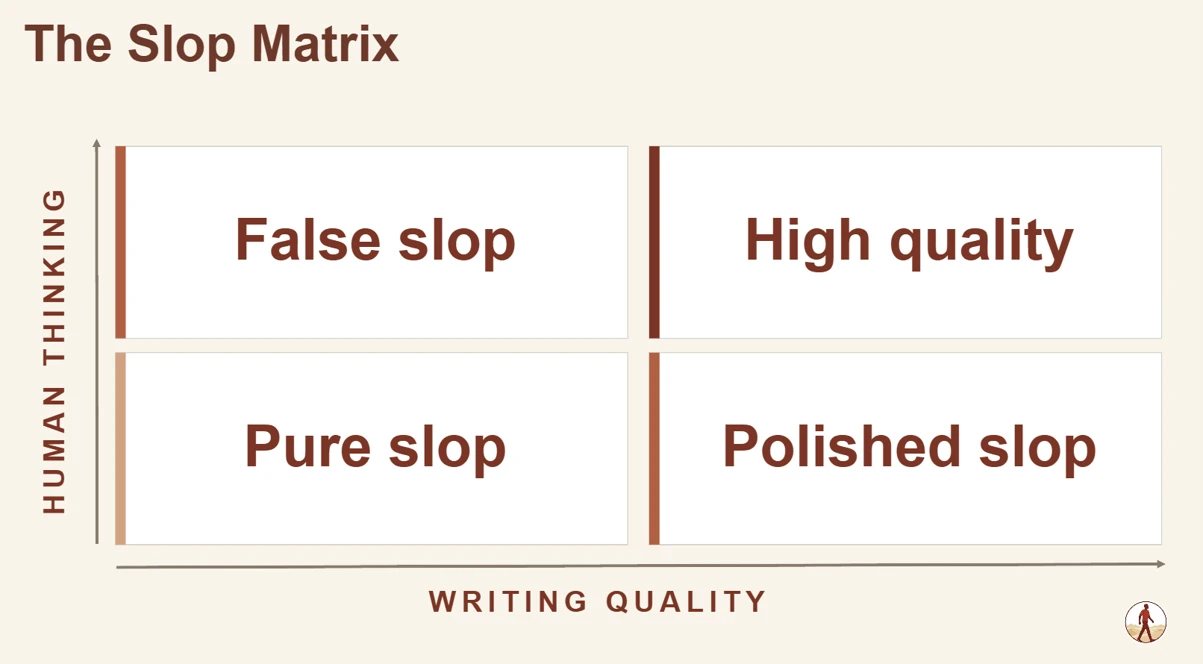
Let’s review each quadrant of the matrix one by one:
Pure Slop: Little or no human thinking, and poor or generic writing. It has almost no value to anyone, it costs the reader time, and it should be avoided at all costs. If you are producing it, please stop.
False Slop: Here a lot of human thinking has gone in, and there may be a great deal of value in the content, but the writing lets it down. The writer may have used AI and the result can be clumsy or overlong, or the point is buried, and so the reader dismisses it as slop and moves on. The quality of the thinking and the points on offer get lost. I call it false slop because it isn’t slop and it has value, but it gets easily mistaken for pure slop.
Polished Slop: Little or no human thinking, but high-quality writing. It looks good on the surface, it sounds good, and it may carry no sign of having been written by AI even if AI did most of the work. Because there is nothing behind it, it should still be classed as slop, and it has very little value. The danger is that it gets read, forwarded, and potentially also acted on.
High quality: A decent amount of thinking, written well, and this is what we should all be aiming for. It’s worth saying that AI can be involved in producing it, and the tool isn’t the problem if the quality of the output is high.
It’s worth adding that different tasks need different levels of thinking. A calendar note and a strategy paper don’t need the same effort, and the matrix works only if you judge each piece against the appropriate level of thinking. We should also acknowledge that AI isn’t the only cause of slop, and there is plenty of human-generated slop too. AI didn’t create this problem, but it certainly has exacerbated it.
What to do about it
Next time you read something and feel the word slop forming, ask yourself which quadrant it’s in. If there are signs of thinking and opinions, it may be false slop, and the thinking is worth consuming. If it reads well but very generically, it’s more likely to be polished slop, and there’s less value within it. Knowing which you are looking at tells you how to approach the content.
If you use AI to write, it’s worthwhile taking the time to build your own AI writing skill, trained on how you write. There is no single standard of high-quality writing, and most of us have a style of our own, which is something to keep as we adopt AI. Generic AI writing risks your work being mistaken for pure slop, even if plenty of thinking has gone into it.
I’d be interested to hear whether this matrix is useful and where you’re seeing each of these forms of slop. My guess is that polished slop is far more common at work than most of us have noticed, precisely because it is designed to be missed.
Sources
Merriam-Webster (2025) ‘Word of the Year 2025: slop’. Announced 15 December. Available at: merriam-webster.com/wordplay/word-of-the-year (Accessed: 2 September 2026).
Niederhoffer, K., Kellerman, G.R., Lee, A., Liebscher, A., Rapuano, K. and Hancock, J.T. (2025) ‘AI-generated “workslop” is destroying productivity’, Harvard Business Review, 22 September. Available at: hbr.org/2025/09/ai-generated-workslop-is-destroying-productivity (Accessed: 2 September 2026).
Workday (2026) ‘New Workday research: companies are leaving AI gains on the table’, press release, 14 January. Available at: newsroom.workday.com (Accessed: 2 September 2026).