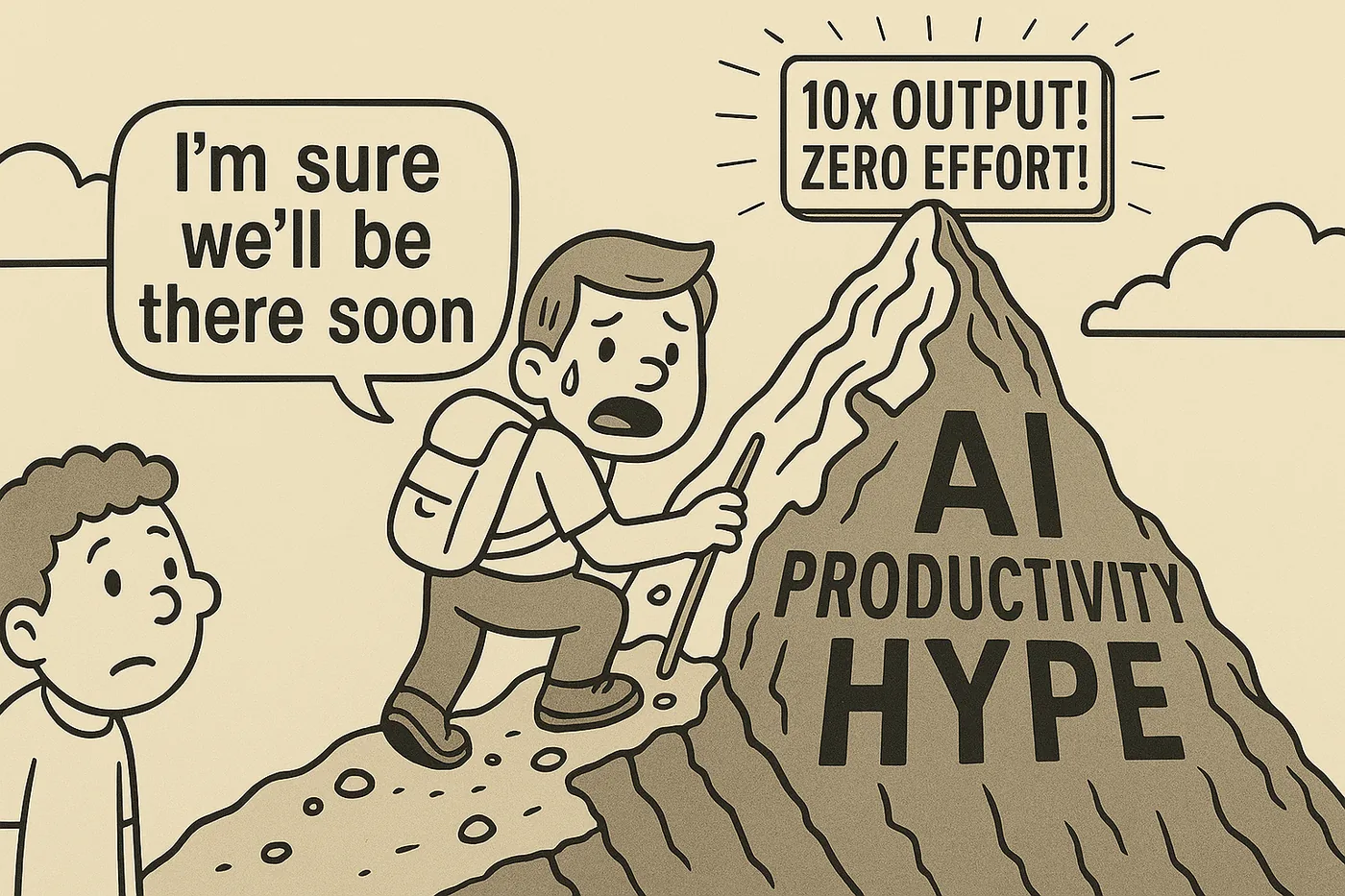
The reality behind the hype
You may already be using AI to draft emails and documents, generate ideas, or summarise meetings, and if you’re seeing notable productivity gains from these tasks, then congratulations because you’re ahead of the curve! But don’t worry if you’re not yet seeing notable productivity gains from your AI use because you’re not alone.
The Hype: Recent years have seen headlines proclaiming AI as a transformative force poised to revolutionise every aspect of work. Headlines and reports have declared that AI can 10x productivity, AI will write 90-100% of code in future, and as many as 30% of jobs could be automated by 2030. If these numbers are to be believed, shouldn’t you be seeing more significant gains when you use AI?
The Reality: Most people I’ve spoken with haven’t yet seen noteworthy gains from using AI, and I frequently speak to people spending as much time editing and re-editing AI outputs as they would have spent writing those outputs from scratch. Failing to see an AI productivity gain is common, particularly when people haven’t been properly trained on how to get the best out of their AI tools or when workflows haven’t evolved to take AI tools into account. This lack of significant productivity gain shows in the data, and although reports vary on exactly how much time people are saving with AI, the average AI productivity gain in early 2025 seems to be only around 7% or 2-3 hours per week. This average is increasing and up on 2024, but it’s still small compared to where it could be.
You’ve made a great start if you’re already regularly engaging with AI tools, and the reality is that most people haven’t yet experienced the game-changing productivity boost that the media touts. So what’s behind this gap between the media narrative and real-world usage? This discrepancy isn’t due to a lack of effort or desire. It’s a reflection of the current stage of AI literacy and AI integration into the workplace.
Many organisations are still exploring how best to implement these tools effectively and responsibly. Most medium-large organisations already have successful pockets of AI implementation, but those AI capabilities are rarely spread effectively across entire organisations. The Boston Consulting Group 2025 AI Radar survey reported that 71% of organisations had trained fewer than 25% of their workforce on AI, so there is a lot of training to do on upskilling employees. There are also many AI policies to write, workflows and processes to be redesigned, and large volumes of data to be cleaned if high levels of productivity gains are to be realised.
This may sound like a lot of work and therefore the pace of successful AI implementation will be varied, but the rewards will be significant for organisations and individuals that move quickly and get this right.
Where the gains are already happening
While the average productivity boost from AI remains modest, some industries and roles are already experiencing headline-grabbing gains. Understanding these success stories provides valuable insights into where AI currently delivers the most value, and why these cases are currently exceptions rather than the rule.
-
Software development and coding already show significant benefits of AI implementation. Of the 65,000+ developers who responded to the Stack Overflow 2024 Developer Survey, 81% agree increasing productivity is the biggest benefit of AI tools and I’m sure that number will have increased since then. Reassuringly, 70% of those professional developers do not perceive AI as a threat to their job, and rather they see it as a tool that will increase their productivity.
-
Content creation stands out as another clear segment where AI can provide significant productivity gains, with copywriters, marketers, and communications specialists reporting significant time savings. Recent reports from Zebracat and Jasper’s 2025 State of AI in Marketing giving impressive statistics on these gains. It’s important to retain your voice with AI-generated content, so I don’t suggest using AI to fully produce content. However, it can quickly get you 80-90% of the way if you have good prompting techniques, and you should always ensure a thorough human review before the output is finalised.
-
Customer support has also seen meaningful improvements through AI-powered triaging and response suggestions. Zendesk’s 2025 CX Trends report shows 79% of customer experience agents believe having AI as a co-pilot increases their abilities, enabling them to deliver superior customer service. Again, the key distinction in successful implementations is that AI augments human agents rather than replacing them entirely.
What separates these success stories from areas still struggling? Three factors consistently emerge:
-
Well-defined scope: The most successful implementations focus AI on specific, clearly defined tasks rather than broad responsibilities
-
High-quality training data: Teams with structured, accessible historical data see better results than those with fragmented or inconsistent information
-
Reimagined workflows: Rather than simply inserting AI into existing processes, the biggest gains come from rethinking workflows around AI capabilities
These patterns suggest that while general productivity gains remain modest, targeted AI applications with appropriate expectations and infrastructure can deliver transformative results. The challenge facing most organisations isn’t the AI technology itself, but the people changes required to fully leverage AI.
Strive for progress, not perfection
If you’re looking to achieve meaningful AI productivity gains, then I suggest developing a consistent practice of small improvements rather than searching for the perfect tool or perfect prompt. Think of it as compound interest for your workflow; many smaller gains that add up dramatically over time.
One successful technique is to start by identifying those repetitive tasks that drain your time and don’t leverage your unique skills. For many knowledge workers, this includes drafting routine communications, organising information, and performing initial research. These areas typically offer the lowest-hanging fruit for AI productivity gains.
Then review that task list and pick a task or process to start where you think AI may be able to help you. Spend 10-15 minutes coming up with ideas on at how AI can help you save time with that task - remember you could even use AI to help you with suggestions here! Then give it a go, and next time you need to do that task, try using AI too. It doesn’t matter if you don’t get the prompt perfect first time around, and the key thing to start with is experimenting and looking for small wins. This practice builds confidence and helps identify patterns where AI works best for your specific needs, and over time you’ll refine your prompts and increase those productivity savings. Share what you find with colleagues, and encourage others to share too. Even saving just 15 minutes per working day translates to more than 60 hours annually - well over a full working week!
Remember that the most productive AI users aren’t those with perfect prompting skills - they’re the ones who consistently experiment, refine their approach, and integrate these tools into their daily workflow.
From playing to building
If you’re a more experienced generative AI user you might be stuck in what we could call the 'prompt plateau', that stage where you’ve mastered basic AI interactions and have become good at prompting, but haven’t yet harnessed AI’s deeper capabilities. Moving beyond this plateau requires shifting your mindset from simply using AI tools to actively building with them.
The first step is developing a systematic approach to prompting. Rather than crafting one-off prompts for each task, create reusable templates for common workflows. For instance, develop a standard prompting template for content reviews, data analysis, or creative brainstorming. This approach not only saves time but leads to more consistent results.
Next, focus on stringing AI interactions together to solve multi-step problems. Instead of viewing each AI use as isolated interactions, consider how outputs from one prompt can feed into another. For example, you could use one prompt to organise information, another to analyse it, and a third to communicate findings. This approach lets you tackle more complex challenges that a single prompt may not address effectively.
For those of you with some technical background, bigger breakthroughs come from integrating AI tools more deeply into your workflows and looking at agents or automations. Even basic integrations, like automatically feeding meeting transcripts to your AI for summaries or connecting document repositories for context-aware assistance, can dramatically increase your productivity. You could also consider building small custom tools that combine AI with your organisation’s specific knowledge and data. Alternatively, platforms like Zapier, Make, and Microsoft Power Automate allow you to create automated workflows without writing code, and all of them now offer AI integrations that are accessible to non-developers.
Remember that the most valuable AI implementations don’t simply automate existing work and instead they enable entirely new possibilities. Ask not just 'How can AI help me do my current work faster?' but 'What else could I accomplish if certain tasks were automated completely?'. The path from playing with AI to building with it isn’t about technical complexity, but it’s about developing an approach that integrates AI as a component in your broader workflow rather than using it as a standalone tool.
The Red Giant says...
Don’t worry if you’re not yet seeing huge productivity gains from AI. Most people aren’t. If you’re using AI regularly and starting to see small improvements, you’re already ahead of the curve. Keep experimenting, keep iterating, and remember that small gains can significantly add up over time. And don’t forget you can use even AI to help if you’re not sure where to look for your next productivity gain.
In my experience, wins often come when you convert 'unknown unknowns' (where you’re unaware of what you don’t know) into 'known unknowns' (where you become aware of what you don’t know). For example, moving from 'I didn’t know AI could help with meeting summaries' to 'I know AI can summarise meetings, but I’m not sure how to implement it effectively.' This comes from experimentation, talking about AI, and sharing results. Once you’ve reached the stage of known unknowns, then you can make much better informed decisions about your next steps.