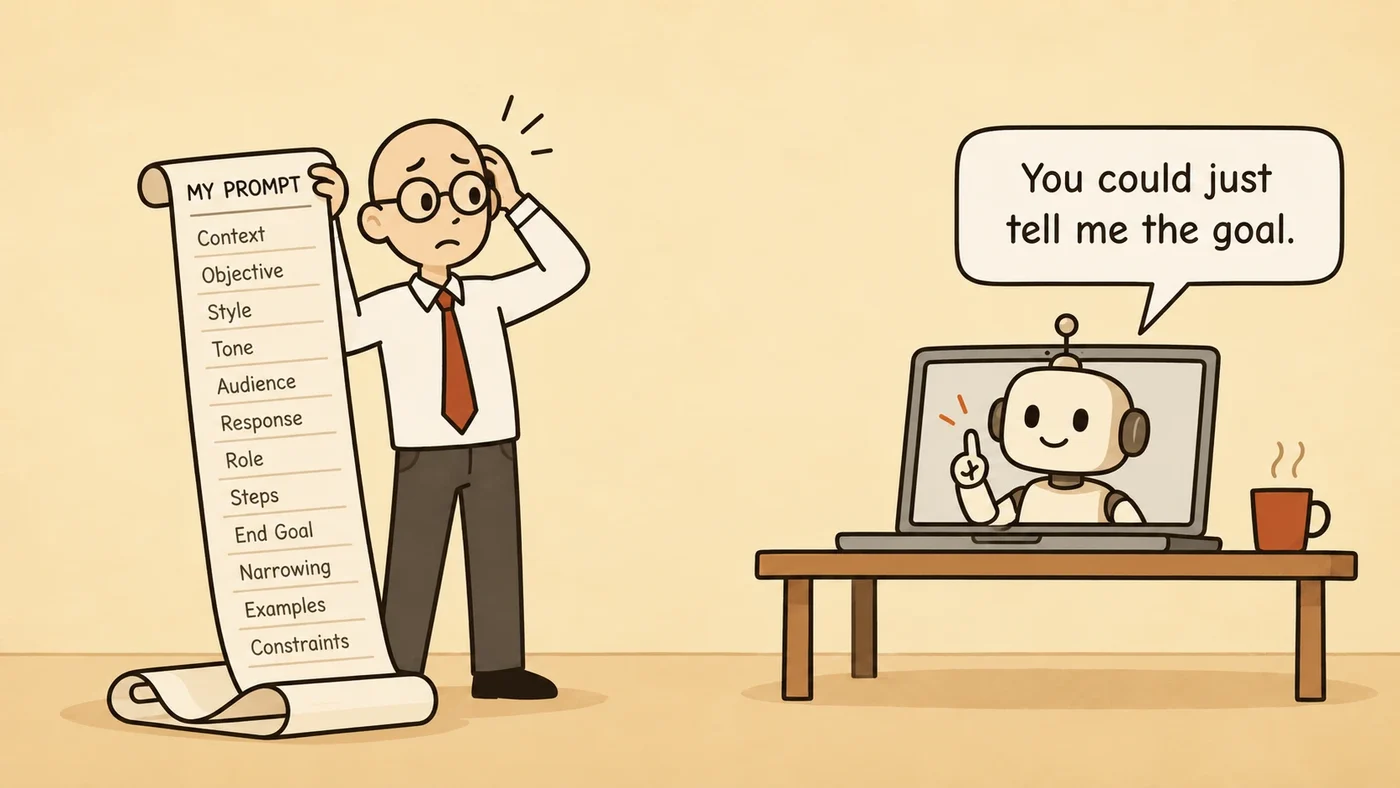
As AI capability has increased, the best ways to prompt AI have changed and become a lot simpler, so if you’re still prompting the way you were a year ago, it’s time to update how you do it.
Learning a prompting framework used to be a key part of AI literacy, and one of the most important things you could learn to start getting better responses from AI. There were many different frameworks, such as CO-STAR and RISEN, and they were all different ways of doing pretty much the same thing. Following one of those frameworks generally got you better results from AI and it still works, but it’s no longer necessary. Prompting now is very different, and Boris Cherny, who leads Claude Code at Anthropic, summed up the change in a post on X on 6 October:
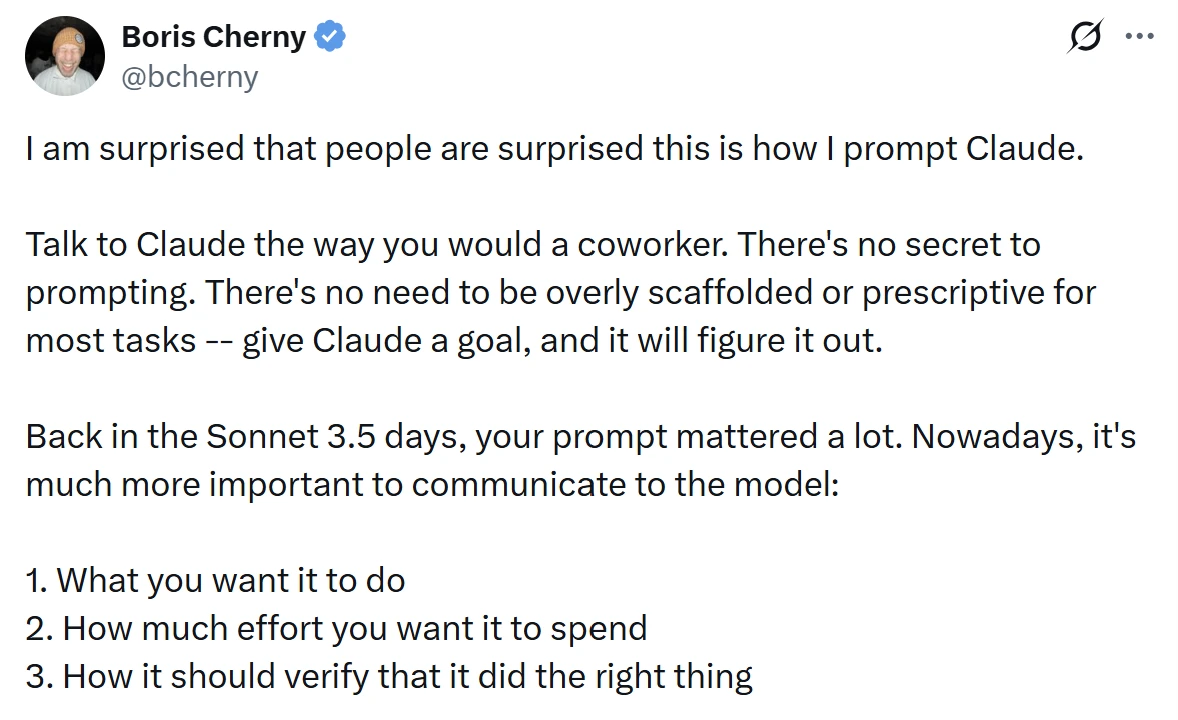
Sonnet 3.5 was one of Anthropic’s models released in 2024, and the frameworks helped back then because the models of that time needed the help to give a good answer. The models have improved so much since that the frameworks are no longer necessary, and in my experience this applies to the free versions of ChatGPT, Claude and Copilot as much as to the paid ones.
Why learning to prompt still matters
So why do I still teach people a prompt structure? Because following one builds a habit that matters as much as ever, which is making sure the AI has everything it needs to complete the task you give it. When people start using AI, I typically find the same three things are missing. They regularly don’t give the AI enough context, they’re unaware of how much giving it a one-sentence role can change the response, and they aren’t specific enough about their goal. Those are three separate habits, and following a basic structure when you start out is still the quickest way to develop them.
Context, Role, Goal
The structure I teach is Context, Role, Goal, which is much simpler than the frameworks that came before it. Each part is worth understanding properly, because together they’re the answer to how you should prompt now.
Context
Context is all of the background information the AI needs to know in order to complete the task. That includes details of the situation behind the task, and any data or documents the AI needs access to. As your setup becomes more mature, context more often exists in memory and in project files, and you’re directing the AI to where it can find the context rather than providing it each time.
Role
The role is one or two lines telling the AI how it should act. Long, detailed personas were common when the models needed more help, but researchers (Basil et al., 2025) found that telling AI to act as an expert made no reliable difference to the accuracy of its answers. However, they also note that a role may still shift perspective and tone, and in my experience including just a single line can still make a significant difference to how the AI responds. Learning to give AI a role is also a useful skill because it’s a step towards working with agents, which are typically set up with a role of their own.
Goal
The goal is what you’re trying to achieve, and it’s where the specifics of the task sit, including the format you want the answer in. Most importantly, the goal should say what good looks like, and it’s where examples belong, because AI systems are very good at following examples. The goal should also include what to leave out, and any limits on what the AI should and shouldn’t do. The habit of clearly specifying a goal also carries forward as you move towards working with agents, which can be given a goal and left to work out the steps, and that’s the heart of Cherny’s advice to “give Claude a goal, and it will figure it out.”
Other ways prompting is evolving
Dictation is changing how people prompt, and learning to dictate to AI rather than typing is one of the most beneficial changes you can make. Speaking a prompt is much faster than typing it, and in my experience the results are better too. We tend to filter ourselves when we type, making decisions about what to put down, whereas when we speak we give the AI a fuller picture. It doesn’t matter that a spoken prompt is less tidy or less structured than a typed one, because the AI systems are now designed to cope with that well and to sort through your dictations.
Prompts can also be much shorter now and don’t always need a lot of detail, particularly partway through a conversation when the AI already has an established role and access to relevant context. Allie Miller, a leading voice in using AI at work, posted a list in August of eighteen two-word prompts she’s “kind of obsessed with”. They include “interview me”, which asks the AI to pull out of you the context you didn’t think to give it, and “automate this”, for when you realise you’ll need to do a task again and want the AI to turn it into something repeatable.
I regularly use short prompts like “What’s next?” and “Why not?” myself, and it’s a habit worth getting into.
What to do next
Look at the way you prompt and the quality of the outputs. If you’re not getting the right response, consider whether you need to give more context, be more specific about the goal, or whether changing the AI’s role would make a difference. If you haven’t tried giving the AI a role, I’d also suggest finding some time to experiment with it, by giving it the same prompt with a few different roles to see how the response varies.
More importantly, keep up with the fact that AI is continually evolving, because the techniques you needed to get decent results a year ago are no longer the techniques you need today, and I’m pretty confident that will continue to change.
References
Basil, S., Shapiro, I., Shapiro, D., Mollick, E., Mollick, L. and Meincke, L. (2025) “Prompting Science Report 4: Playing Pretend: Expert Personas Don’t Improve Factual Accuracy”, Wharton Generative AI Labs, December. Available at: gail.wharton.upenn.edu/research-and-insights/playing-pretend-expert-personas (Accessed: 13 October 2026).
Cherny, B. (2026) Post on X, 6 October. Available at: x.com/bcherny/status/2107565388250874193 (Accessed: 13 October 2026).
Miller, A. K. (2026) “18 two-word AI prompts I’m kind of obsessed with”, post on X, 12 August. Available at: x.com/alliekmiller/status/2087558225029689618 (Accessed: 13 October 2026).