I believe everybody should receive at least basic AI literacy training. The market for delivering training is filling up fast and becoming more competitive, so how do you tell the good from the average, and what should good AI training actually look like?
I’ll acknowledge the self-interest of this article up front: I train people on AI for a living, so this article is partly an argument for hiring me. I’ve delivered AI training to over 2,000 people across sectors including higher education, financial services and construction, which gives me a basis for the checklist below. However, this checklist should also serve as a list of things to look for whoever you get your AI training from.
It starts with understanding you
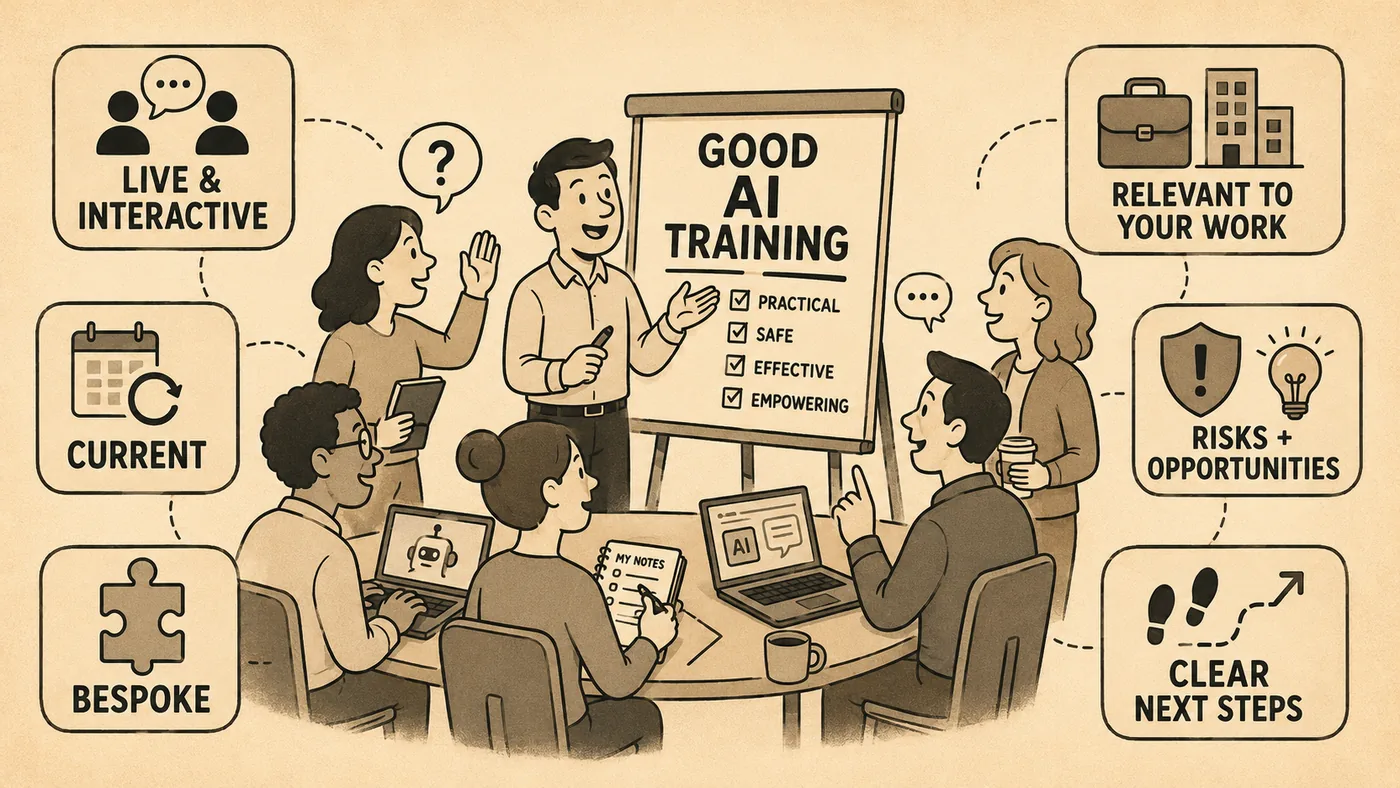
The single biggest predictor of whether training delivers value is whether you and the trainer have aligned on what it will cover. That means a proper conversation beforehand: what tools your people have access to, what the regulatory and commercial context is, what they already know, and what you want them to be able to do afterwards. The exercises, the examples, and the framing should be shaped around your world. Much of the underlying theory will be consistent, but people need to know that the training is relevant to their roles and their industry, and it’s not too much to expect a trainer to have a conversation with you and do some research on your industry in advance.
It’s live and interactive
For AI training, learning how to use AI from videos that quickly become outdated doesn’t really get you very far. AI is something you learn best by doing, and that requires live training with someone who can keep people on track, adjust the pace as necessary, answer the questions they’re trying to ask, and notice when people haven’t been able to follow the exercises. In the workshops I run, I spend as much time as possible with people on their own laptops, trying things and giving them help when they get stuck. In person is ideal because you can walk around and look at people’s screens, but I acknowledge that live online is often more practical to arrange.
It’s current
AI is moving fast and the pace of change is accelerating. The tools, the capabilities, and the emerging consensus on what’s working in businesses shift month by month and week to week. Good training reflects where things are at the time of delivery. That means working with someone who is actively using these tools themselves and refreshing their material constantly. A straightforward way to test this: ask a prospective trainer what they’ve changed in their material in the last month, or which tool they’ve been using most this week. If they struggle to answer, that tells you something.
It covers the risks and the opportunities
Good training doesn’t just teach people how to use AI. It helps them understand what it means: for their sector, their organisation, and their role. That includes helping people uncover and understand opportunities where AI can meaningfully accelerate work, which use cases are proving out in their industry, and the competitive implications. Good training should also cover the risks associated with AI: shadow AI (staff using personal AI tools at work without oversight), data protection and compliance exposure, over-reliance, and the limitations of the tools. People should leave understanding what AI can’t do just as clearly as what it can. That calibrated judgement is more valuable than a list of generic prompts.
It builds on your expertise
A lot of AI training focuses on valuable skills like how to prompt, but that doesn’t help if the training doesn’t also help you understand how to use AI well in your specific role, alongside the expertise you already have. The real value comes from learning to use AI in a way that builds on what you already know: interrogating the output rather than accepting it, applying your own expertise to shape and challenge what AI produces, and building the judgement to know where it helps and where it doesn’t.
It’s engaging and meets people where they are
Pretty much every training session I’ve run has included people with a wide range of experience and opinions about AI. In any training session there are typically people who are already enthusiastic about AI, and people who are nervous about it, people who regularly use AI, and people who rarely use it. Good training should cover all of these groups. It keeps the enthusiasts engaged without leaving the sceptics behind, and it takes concerns seriously rather than brushing them aside. It should also, frankly, be fun. People learn better when they’re engaged and retain more when they enjoy themselves. The best sessions are the ones where people are still talking about what they did weeks later.
It’s designed for what happens next
You can’t learn AI in a day. The people who develop real capability are the ones who keep going after the session: practising, experimenting, applying what they covered to their actual work. Good training is designed with that in mind. People leave with very clear next steps, specific things to try grounded in their own role, and ideally a way to come back with questions as they practise. A session with no follow-through and no expectation of practice will leave most people roughly where it found them within a fortnight.
That’s my starting checklist. There’s plenty more that goes into a good session: how to design exercises that build progressively, how to ensure inclusivity, how to balance group work and individual practice, but if your training provider can give you honest, specific answers to the things above, you’re in good shape. If they can’t, keep looking.