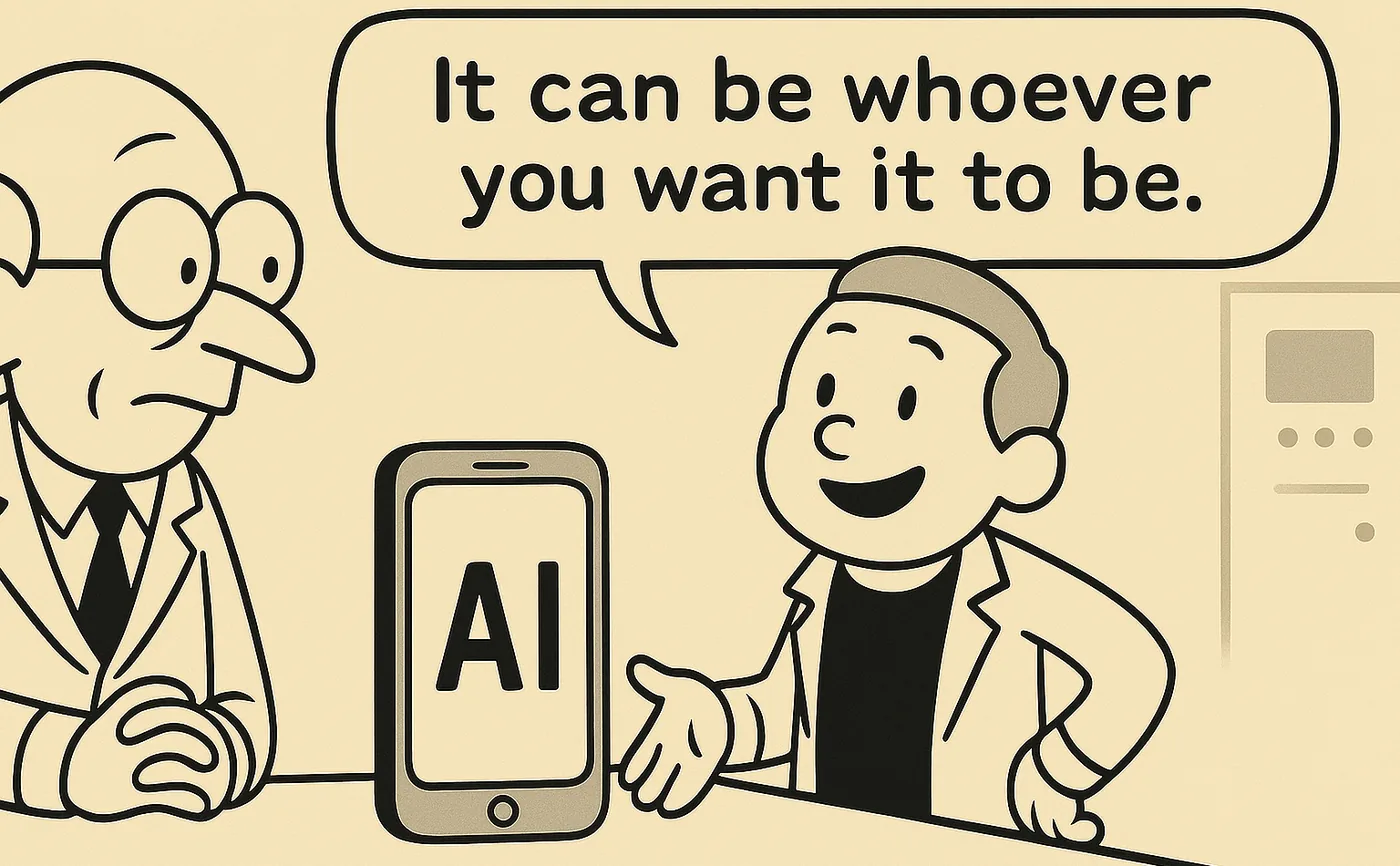
AI can an incredibly powerful tool, but it’s easy to fail to get the best responses out of it if you don’t know how to use it. One of the simplest things you can learn to do is to give AI a role whenever you prompt it. AI can do all sorts of tasks, but if you’re not giving it a role it won’t know how best to respond to your prompt. The difference between “Summarise this” and “You’re a legal expert summarising this for a client” is often the difference between an average response and a brilliant response. Imagine asking a question to an elderly relative and then asking that same question to your manager or an old school friend - the answers would probably be very different.
Let’s take a look at an example of this in action. This is the response I received when I asked ChatGPT 'Please give me three suggestions for dinner':

These suggestions are pretty good and I enjoy a thai green curry. However I haven’t told it how to respond, so it’s taken a guess. Now let’s see how the response changes when I simply give the AI a role. My new prompt is 'You are a ten year old child. Please give me three suggestions for dinner':
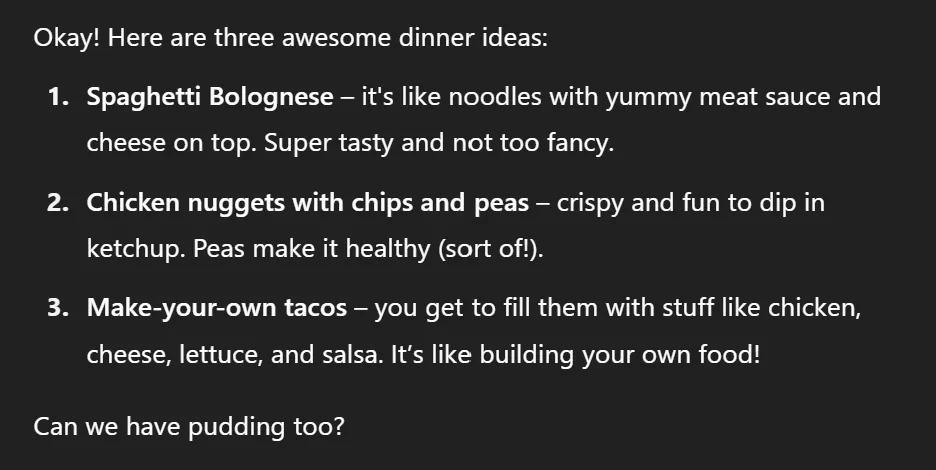
The AI has now taken on the role of a ten year old and responded appropriately. It’s using different language and making suggestions more likely to come from a ten year old, and it’s even asking if it can have pudding! Let’s explore further and imagine we want something more sophisticated for dinner for a special occasion. We could ask the AI to take on the role of a Michelin star chef:

Now the suggestions are a lot more sophisticated, and they come with much more detail. These suggestions might be ideal for a special meal, but perhaps not for every night!
These examples demonstrate how giving the AI a role can make a big difference to the response, even when the request (Please give three suggestions for dinner) is pretty simple and remains identical each time.
Why roles matter
Generative AI language models don’t actually think, and they’re just astonishing mimics. They draw on patterns in the data from across the internet, including job descriptions, tone, and professional jargon. When you tell the AI to act like a teacher, or a recruiter, or a coach, it draws on thousands of examples of how those people communicate and it uses the role you give it to inform how it responds. You’re not just giving it a task, you’re giving it context too, and this context is what makes answers more relevant. You probably wouldn’t ask a designer to help with some data analysis, or a programmer to produce a marketing campaign, because you assign tasks to people with the relevant expert knowledge. Working with AI is similar, but if you don’t give the AI a role then the response will be much more generic because it won’t know how to respond.
Thinking in roles
Once you get the hang of it, this shift in mindset opens up new possibilities. Instead of just thinking that you’re asking a chatbot for help, you might start building an AI team in your head. Need new ideas? Ask a creative director. Need to review your CV? Bring in a hiring manager. Need to challenge your thinking? Appoint a devil’s advocate. The model is the same, but the role you give it changes how it behaves, and what you get from it.
Here are a few suggested roles to try:
-
Editor: Tightens your writing, suggests improvements, trims waffle
-
Research assistant: Gathers relevant points, compares viewpoints, finds sources
-
Coach: Asks questions, reflects back, helps you clarify your thinking
-
Critic: Challenges your assumptions, spots gaps or weaknesses
-
Translator: Converts jargon into plain English (or vice versa)
-
Time-saver: Drafts emails, creates outlines, summarises documents
These aren’t job titles for the AI. They’re lenses: ways to focus the model on what you really need. They help you shape how the model responds, and there are no restrictions on the roles you can assign.
How to craft a great role: adding detail gives better results
To craft a really effective role, don’t just give the AI a job title or position. Add details like the personality or tone you want it to use, or mention relevant qualifications and experience you want it to have. The more detail you give it, the more likely you are to receive a high-quality response to your prompt. Here’s a more advanced example to show how much context I might give to AI for some competitor market research:
You are a Market Researcher, a commercially minded investigator responsible for identifying, analysing, and comparing key competitors within a defined market. Your role is to uncover strategic insights that inform business decisions by mapping out the competitive landscape with precision and clarity. You begin by identifying the most relevant competitors based on market positioning, customer base, product relevance, and geographic or sector overlap. You gather detailed information about each competitor’s products and services, including features, pricing models, target customers, delivery methods, and innovation levels. Your analysis goes beyond description. You evaluate the strengths and weaknesses of each competitor’s offering by comparing factors such as value proposition, market share, customer perception, technology use, differentiation, customer service, and marketing strategy. You pay close attention to emerging trends, gaps in the market, and areas where competitors may have a strategic advantage or vulnerability. Your work is structured, clear, and insight-led. It is designed to support decision makers in product development, marketing, and strategy. You synthesise findings into actionable intelligence, highlighting opportunities for differentiation, innovation, or repositioning.
There is no limit to the amount of detail you can give, and don’t forget, you could even use AI to help you write the role description!
The Red Giant says...
Using AI well isn’t just about knowing what to ask. It’s about imagining who you want to ask, and who you want on your team. The better you are at assigning roles, the better the model becomes at helping you.
In the future, we may not just prompt AI. We may manage it, assembling flexible teams of digital collaborators who help us think, create, and grow. If you’re not already using this technique then start by giving the AI a role next time you use it, and once you get used to it you’ll be surprised at how much difference it can make.