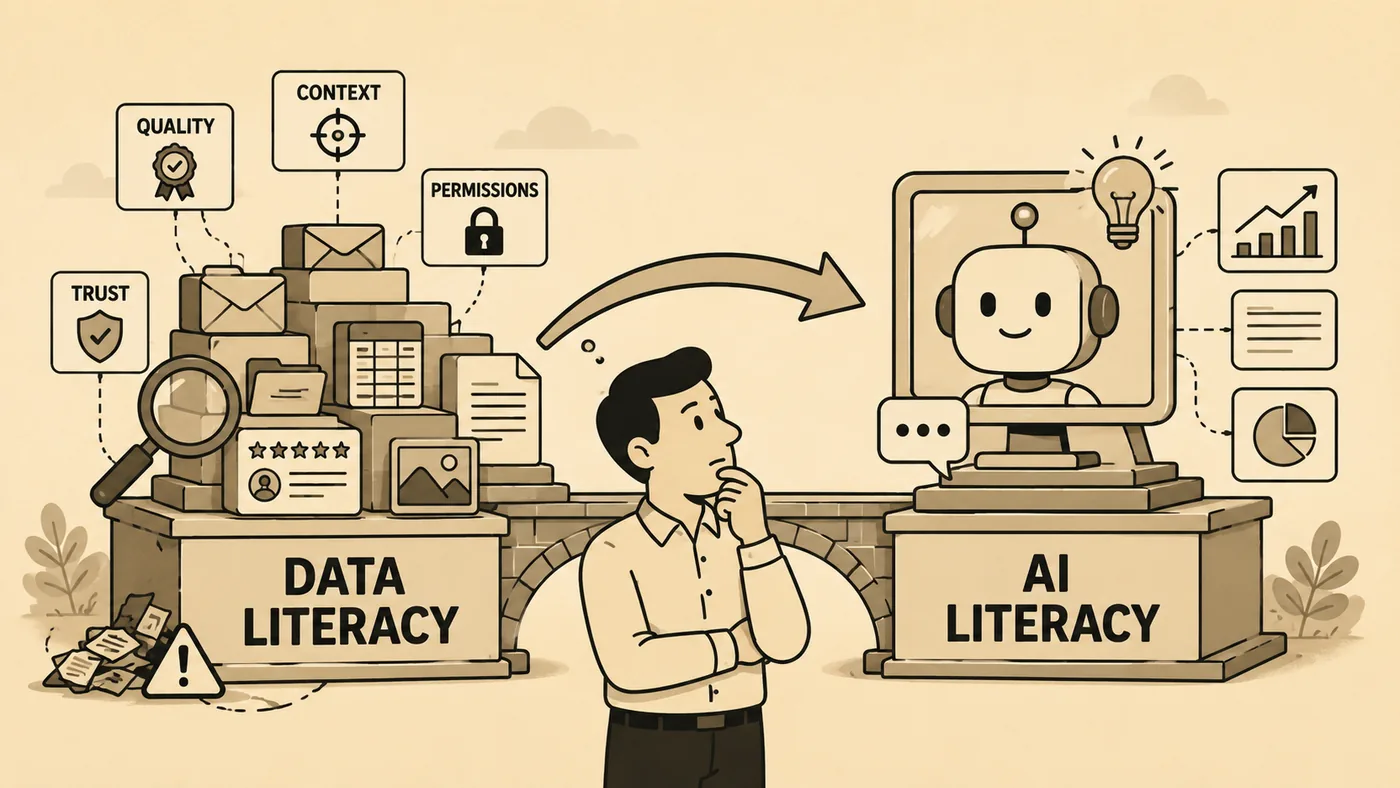
Data literacy is a frequently overlooked part of AI literacy. If your AI literacy training doesn’t cover data then that’s a common gap. In DataCamp’s 2026 State of Data and AI Literacy report, a survey of more than 500 US and UK leaders, 88% said basic data literacy matters for their people’s day-to-day work, yet only 42% of their organisations provide training in it across the workforce. It’s worth understanding why data literacy matters so much to AI literacy.
The main reason is very simple: AI runs on data. The quality of anything an AI system produces depends on the quality of the data it was built on and the quality of the data you give it. If people can’t think clearly about that data, they won’t be able to think clearly about the AI either. Data literacy enables someone to use AI tools well and to judge the outputs.
It helps to clarify what data literacy actually is, because it’s often misunderstood as being good with numbers or comfortable in a spreadsheet. It’s broader than that, because data includes the emails in your inbox, the notes from a meeting, a set of customer reviews, the photos in a shared drive, and the contracts in a folder somewhere. Being data literate means being able to make sense of all of it: where it came from, what it actually tells you, what it leaves out, and what you can trust.
For an organisation, data literacy typically shows up as groundwork for AI literacy. AI is only as useful as the data it can reach, so a data-literate organisation:
-
tidies up and clears out duplicate files that could provide AI tools with incorrect or outdated data
-
makes sure AI tools can get to the data they need
-
sets permissions carefully, so employees can’t get to the data they shouldn’t
This data literacy groundwork isn’t glamorous, but it’s a critical part of enabling organisational AI capability.
There’s a competitive edge in the data groundwork too. Every organisation can buy the same AI tools, so the tools themselves give you nothing your competitors can’t have. Your data is the one thing competitors don’t have, which makes it worth treating as a valuable asset.
For an individual using AI day to day, data literacy is more about judgement. When someone uses an AI tool well, they’re questioning the data twice over. On the way in they question what information to give the AI, because a model can only reason about what it can see. And on the way out they question what comes back. If you ask an AI to summarise customer feedback but only feed it last month’s reviews, it will give you a confident summary of a partial picture, and unless you know what it was working from, you won’t spot the problem.
Part of that judgement is knowing what you should and shouldn’t put into a tool in the first place. Feeding confidential or personal data into a public AI tool can mean handing it to a third party, with all the security and confidentiality risks that carries, so recognising that is itself a data literacy skill.
Bias is a data problem too, because an AI system trained on skewed data will produce skewed results, often without anyone noticing. I’ve written a separate article about bias in AI, so I won’t repeat it here, except to say that spotting it depends on the same data literacy skill, the ability to ask what the underlying data represents and who or what it leaves out.
Data literacy also shapes a decision leaders now face regularly: whether a given use of AI is worth paying for. AI is increasingly priced by usage, so working out whether AI use is justified means reviewing the data on usage, time saved and value returned. Without that literacy, it’s easy to keep paying for AI that isn’t providing a return on investment, or to drop AI where it’s adding value.
So when you’re scoping AI literacy training, look at whether it covers data or jumps straight to the tools. What does covering data actually look like? It should be practical rather than technical: where the organisation’s data lives and what state it’s in, what should and shouldn’t go into an AI tool, how to judge what comes back, and how to handle confidential and personal information along the way.
The organisations getting the most from AI treat data literacy and AI literacy as connected capabilities, built at every level, because in practice that’s what they are. The evidence points the same way: in the same DataCamp report, 21% of organisations reported significant returns on their AI investment, but among those with a mature data and AI literacy programme across the whole workforce, that doubled to 42%.